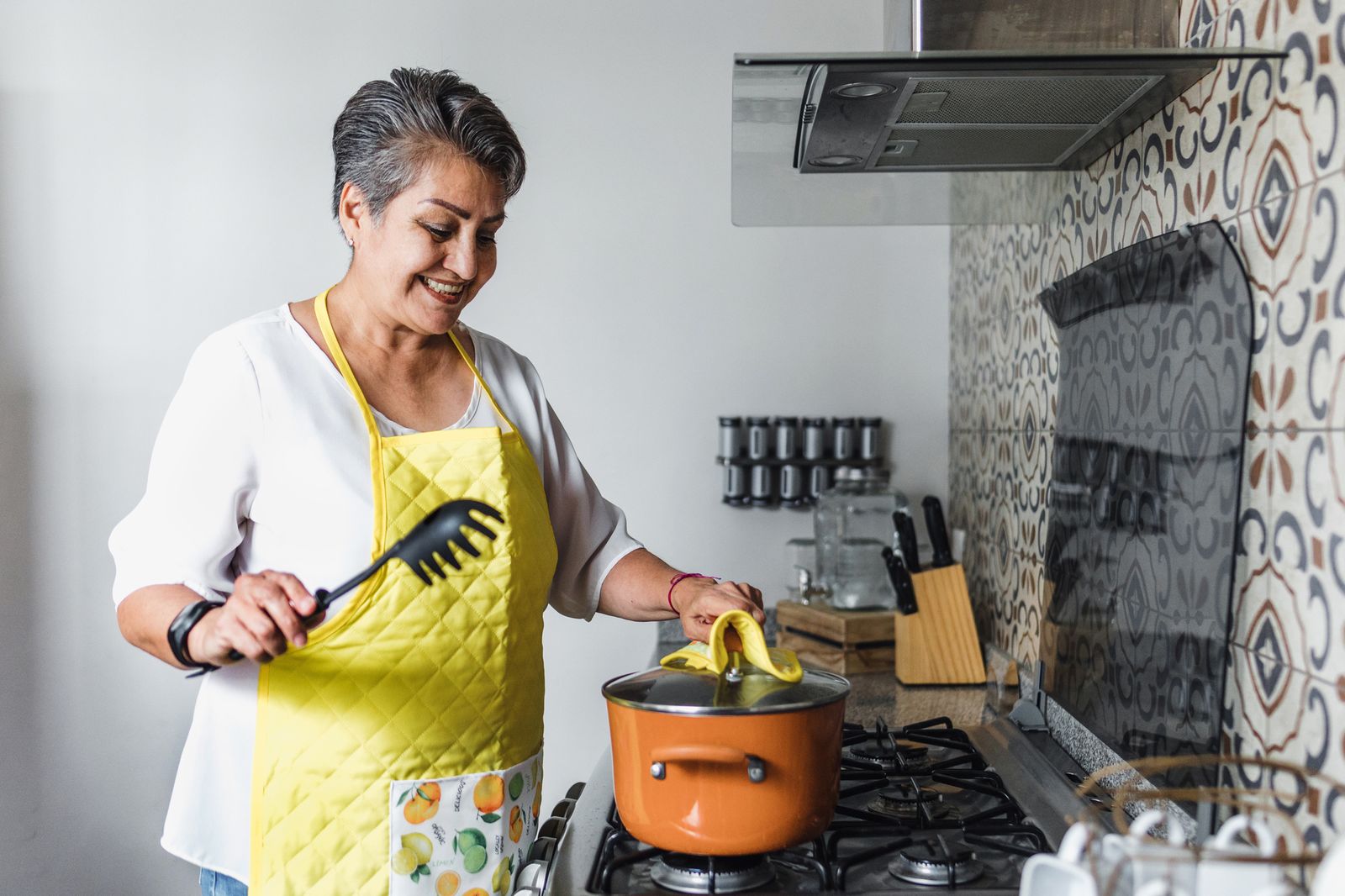
Cooking is one of the first daily tasks to become tiring, and one of the most important to keep. People who stop cooking tend to eat worse and move less. Most kitchens were laid out for a tall, strong adult who never gets tired: heavy pans in low cabinets, everyday dishes overhead, a deep sink and knobs that need a firm grip. Rearranging and a few modest changes go a long way before any remodeling is needed.
Step one costs nothing: rearrange
- Put what you use every day between hip and shoulder height.
- Move heavy pots, mixers and stacks of plates out of low and high cabinets to the counter or a waist-high shelf.
- Keep things where they are used: mugs by the kettle, pans by the stove, knives by the cutting board.
- Give away duplicates. Fewer things means less lifting and searching.
- Clear the counters you work at, so pans can slide instead of being carried.
Storage that comes to you
| Change | What it solves | Effort |
|---|---|---|
| Pull-out shelves in base cabinets | No kneeling and reaching to the back | Retrofit kits fit most cabinets |
| Deep drawers instead of doors | Pots and dishes lift straight up | Cabinet work |
| Lazy Susan or turntable | Corner cabinets and deep shelves | Minutes |
| Pull-down shelf for wall cabinets | Brings upper shelves to counter level | Moderate |
| D-shaped pulls in place of knobs | Opens with a hooked finger, no pinch grip | A screwdriver |
| Open shelf or rail at eye level | Everyday items always in view | Minor |
Pull-out cabinet organizers and D-shaped cabinet pulls are the two upgrades people notice most.
Sink and faucet
- A single-lever or touchless faucet works with a wrist or forearm.
- A pull-down sprayer fills pots on the counter or stove, so a full pot never has to be lifted out of the sink.
- A shallower sink, or a rack in the bottom, reduces bending.
- Set the water heater to 120 degrees Fahrenheit or fit an anti-scald valve.
Working sitting down
Standing for a whole meal’s preparation is hard on backs, hips and knees.
- A sturdy perching stool lets you work at the counter half seated.
- A table or a lowered section of counter, around 28 to 34 inches high with knee space below, suits working from a chair or wheelchair.
- A rolling cart moves food and dishes between the counter and table without carrying.
- An anti-fatigue mat that lies flat with beveled edges helps when standing. Avoid loose rugs.
Appliances
- Stove. Controls at the front mean no reaching over hot burners. Induction cooktops stay cooler and turn off when the pan is removed.
- Oven. A wall oven at counter height, or one with a side-opening door, avoids bending with a hot dish. With a standard oven, pull the rack out before lifting.
- Microwave. On the counter or just below it. Above the stove is the worst place for hot liquids.
- Refrigerator. Side-by-side or French door models put more at reachable height than a top-freezer.
- Dishwasher. Drawer models or a raised installation reduce bending.
- Small appliances. An electric kettle with automatic shutoff, a slow cooker and a countertop oven cover most meals with less lifting.
Fire and burn safety
- Fit an automatic stove shutoff if pans are sometimes forgotten.
- Keep a fire extinguisher by the exit, and know how to use it.
- Check the smoke alarm monthly.
- Wear close-fitting sleeves when cooking.
- Use the back burners and turn handles inward.
- Use a timer every time something is on the heat.
Floor and lighting
- Wipe spills at once, and keep a long-handled mop or grabber nearby.
- Choose a matte, non-slip floor if replacing.
- Add under-cabinet lighting so counters are lit without your own shadow.
- Use contrasting colors: a dark cutting board for light foods, a light one for dark foods.
See lighting a home for older eyes.
If you are remodeling
- Counters at more than one height.
- Drawers in every base cabinet.
- Rounded counter edges and corners.
- At least 42 inches of clear floor between counters, and five feet for a wheelchair to turn.
- Outlets and switches at the front of the counter or at reachable height.
- Knee space under the sink or cooktop, with pipes insulated.
Tools that reduce effort
Layout is half of it. The other half is what is in your hands. See kitchen tools for arthritic hands and jar openers for weak hands.
Frequently asked questions
What is the cheapest change that makes a difference?
Rearranging so daily items sit between hip and shoulder height. It costs nothing and takes an afternoon.
Are induction cooktops safer?
They heat the pan, not the surface, and switch off when the pan is removed, which lowers burn and fire risk. They need magnetic cookware. People with a pacemaker should ask their doctor first.
How do I reach high cabinets safely?
Do not store everyday things there. For the rest, use a reacher for light items, and a wide step stool with a handrail if you are steady on your feet. Never a chair.
Do I need a full remodel?
Rarely. Rearranging, pull-outs, new handles, a lever faucet and better lighting cover most needs.
Next steps
Read the aging in place guide for the rest of the house.
HomeWizy is reader-supported. As an Amazon Associate we earn from qualifying purchases. This article is general information, not medical advice. Ask a doctor or occupational therapist about your own situation.