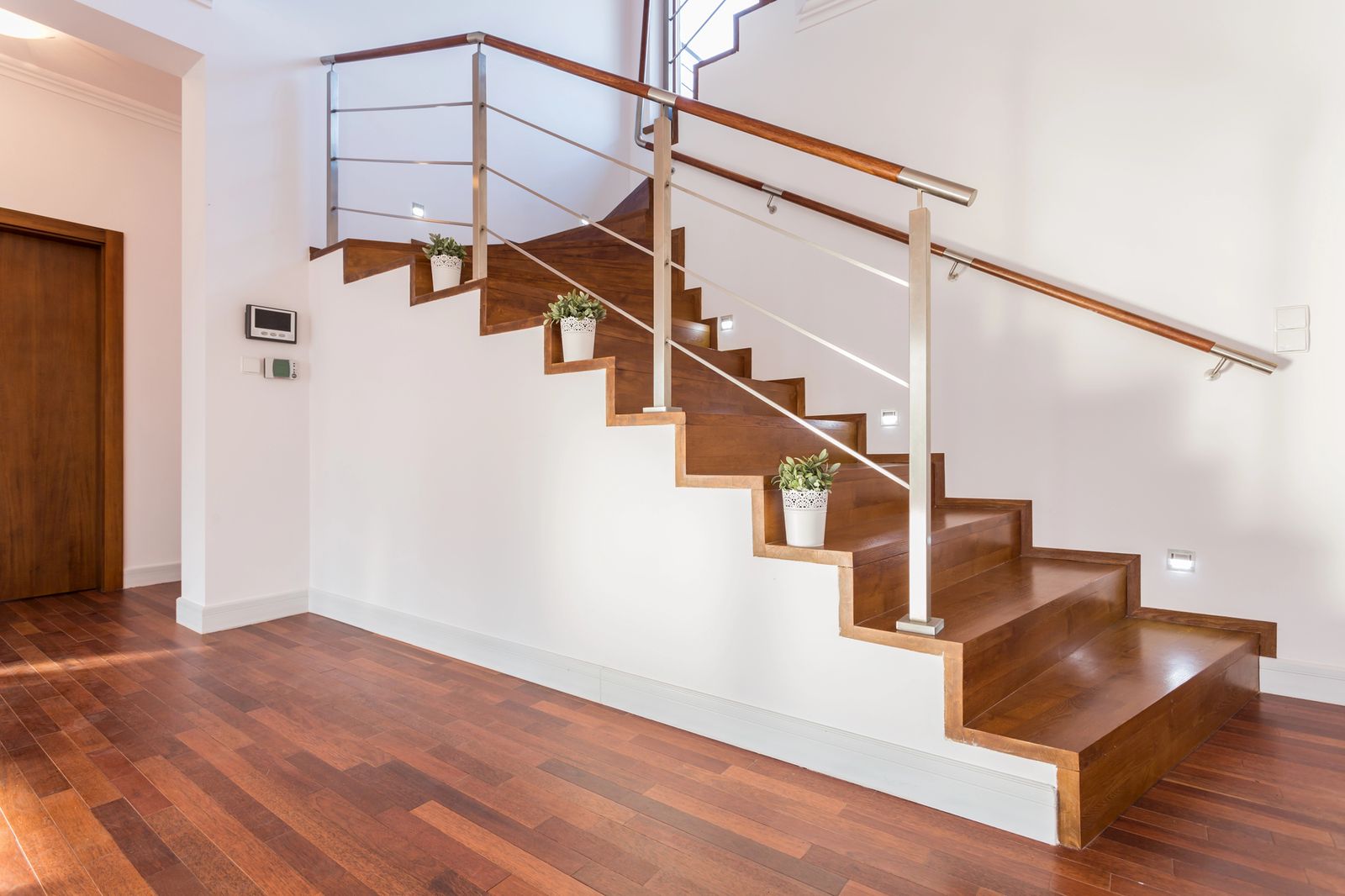
Stairs are where a small slip turns into a serious injury. They are also the reason many people believe they will have to leave a home they love. In most houses neither has to be true. A handful of inexpensive changes makes a staircase far safer, and when climbing becomes too hard there are options short of moving. Work through them in order, starting with the cheapest.
Start with a five-minute check
- Is there a handrail on both sides, running the full length?
- Can you close your whole hand around it?
- Is it firm when you pull hard on it?
- Can you see the edge of every step clearly, day and night?
- Is there a light switch at both the top and the bottom?
- Is the carpet or covering tight, with no loose edges?
- Is anything stored on the steps?
Every “no” is a job for the list below.
Handrails: the most important fix
A second handrail is the single best improvement to most staircases. It gives support on the stronger side going both up and down.
- Both sides. Fit a rail on the wall side as well as the open side.
- Full length, and a little more. The rail should start before the first step and continue past the last, so there is something to hold while stepping on and off.
- Height. Building codes in the US generally call for 34 to 38 inches above the front edge of the steps. Within that range, choose what suits the person’s height.
- Shape. A round rail about an inch and a half across is easiest to grip. Wide, flat decorative rails cannot be held properly.
- Fixing. Brackets must screw into wall studs or solid blocking, not just drywall.
A round handrail kit is a straightforward job for a handyman.
Lighting
- Put a switch at the top and the bottom, or use motion-sensor stair lights that come on by themselves.
- Light the steps evenly. A single bright bulb at the top throws shadows that hide the step edges.
- Add a night light on each landing.
- Avoid glare from a bare bulb or a window at the foot of the stairs.
See lighting a home for older eyes.
Treads and edges
- Mark the edges. A strip of contrasting color on the front edge of each step makes it easier to judge. This matters most on the top and bottom steps.
- Add grip. On bare wood, use non-slip stair treads or clear grip tape.
- Fix the carpet. Tight, low-pile carpet is fine. Loose, worn or thick carpet is a hazard. Patterned carpet can make edges hard to see.
- Remove runners and mats at the top and bottom unless they are fixed down.
- Repair any loose, uneven or broken step right away.
Habits that help
- Keep one hand on the rail, every time.
- Never carry anything that needs two hands or blocks the view of your feet. Use a bag with a shoulder strap, or make two trips.
- Keep the stairs clear. A basket at the top and bottom collects things to be carried later.
- Wear shoes or slippers with a back and a grippy sole. Avoid socks alone.
- Take your time, and turn the light on.
Outdoor steps
- Rails on both sides, even for two or three steps.
- A light that covers every step.
- Grip strips or textured paint on smooth concrete or wood.
- Keep them clear of leaves, moss, ice and snow.
See entryways, ramps and thresholds.
When climbing gets hard
| Option | What it involves | Suits |
|---|---|---|
| Live on one level | Move the bedroom downstairs and add or adapt a bathroom there | Homes with a spare ground-floor room |
| Stair lift, straight | A chair on a rail fixed to the steps. Fitted in a few hours | A single straight flight |
| Stair lift, curved | A rail made to measure for turns and landings. Costs much more and takes longer | Stairs with a bend or a landing |
| Home elevator or platform lift | Building work and a significant budget | Wheelchair users, long-term plans |
| Half steps and extra rails | A lower step height or an added grab point at a difficult spot | One or two awkward steps |
Stair lifts: what to know
- The rail fixes to the steps, not the wall, and leaves room for others to walk.
- Most run on batteries that charge at the top or bottom, so they work in a power outage.
- Look for a swivel seat at the top, a seat belt, and sensors that stop the chair if something is in the way.
- Check the weight capacity and the seat size.
- The user must be able to sit down, stand up and transfer safely at both ends.
- Get more than one quote. Ask about rental and reconditioned units for short-term needs, and about service.
Frequently asked questions
Is one handrail enough?
One is the minimum. Two is much safer, because most people are stronger on one side and that side changes between going up and coming down.
Is carpet or bare wood safer?
Either can be safe. Tight low-pile carpet gives grip and softens a fall. Bare wood needs treads or grip strips.
Does Medicare pay for a stair lift?
Original Medicare generally does not cover stair lifts. Some Medicare Advantage plans, Medicaid waiver programs and veterans’ programs may help. Check with the plan or program.
Should I avoid stairs altogether?
Not unless you have been told to. For many people, using stairs safely helps keep legs strong. Ask a doctor or physical therapist if you are unsure.
Next steps
Work through the room-by-room fall prevention checklist, and read the aging in place guide for longer-term changes.
HomeWizy is reader-supported. As an Amazon Associate we earn from qualifying purchases. This article is general information, not medical advice. Ask a doctor or occupational therapist about your own situation.